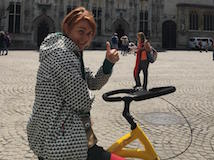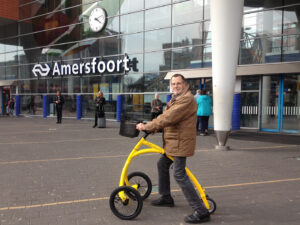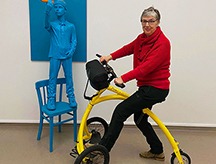
Ellie van Setten spent a day trying out the Alinker in Amersfoort. Below you’ll find her blog post, www.authentist.nl.
Ellie: “I have autism and HSD (hypemobility syndrome), among other things. I write about how these labels influence my life, but don’t define it. Labels don’t define me! I’m Ellie, and I’m an authentic person, looking for a fulfilling life despite my limitations.”
Getest: de Alinker loopfiets
An Alinker? What’s that? Two weeks ago, I had no idea either. Until I Googled “balance bike” while searching for a mobility aid. I saw a picture of a yellow three-wheeled bike without pedals, which actually looked pretty cool; it turned out to be an Alinker. The Alinker is a yellow balance bike with three wheels: two large ones in the front and a small one in the back. It has a sporty handlebar, to which a basket can be attached. You can use it by scooting with one leg, or walking with both legs.
Because the Alinker is quite expensive, I couldn’t just buy it. In some cases, it’s possible to get reimbursement from your health insurance, but not without a doctor’s referral, and this also depends on the insurer’s policies. So, a balance bike isn’t easy to get (I’m already on the waiting list for a doctor’s appointment). Fortunately, you can try the bike out first by renting it from Vierfiets in Amersfoort. You can rent it for a day or a week. Because Amersfoort is quite a drive, I rented the bike for a day first (for €15.50).
On to Amersfoort…
Vierfiets is located in Amersfoort across from the station, but thanks to the parking facilities, it’s also easily accessible by car. Upon arrival, I received a detailed explanation of the bike, was allowed to try it out indoors, and it was properly adjusted for me. Then we headed into town. The first part was downhill, so I got down to the center quickly. I even had to wait for my boyfriend occasionally, which is usually the other way around. After a lunch stop at McDonald’s (because they had gluten-free fries), we went to the Flehite Museum, a history and art museum. I’m particularly bothered by the walking-standing-walking-standing, etc., which you often do in museums or shops, so I wanted to test the bike for its intended purpose. Luckily, Lief had no problem with this, as he loves museums.

To the museum
Arriving at the museum, we literally ran into our first hurdle. Normally, you had to climb stairs to get in. Fortunately, there was a separate entrance for wheelchairs and groups, but you had to ring the doorbell for that. The staff was also very friendly and helpful, and we were allowed to take our bicycle in without any questions. It fit in the main elevator, so we still reached the reception desk. We first visited an exhibition about the liberation on the top floor. Unfortunately, it wasn’t exactly accessible; it was a real maze with very tight turns, and I couldn’t see part of it because the Alinker didn’t fit on the small wheelchair lift. In retrospect, I might have been able to fold it, but then I’d have had to get off and stand next to it on the elevator platform, which seemed quite daunting.


Afterward, we went to the art collection, which I really enjoyed. The exhibition was a bit more spacious, thankfully. Unfortunately, I couldn’t reach a section because of the small wheelchair lift. My friend watched over the Alinker for a bit, and I walked a bit. Finally, we visited the exhibition about the history of Amersfoort. I was already quite tired by then. I missed the support in my back, so I snuck out a bench to lie down until my friend was done. The Alinker did fit in the accessible toilet, which was handy, as there’s no lock on my bike, so I didn’t want to leave it unattended.
Into town with the Alinker
After the museum, we went to explore Amersfoort. I have to say, it’s a nice city, but quite hilly. I also discovered again how accessible it is. I often had to cross the road because, for example, a restaurant had built a patio on the sidewalk, or a car was parked there. My boyfriend wanted to go to a coin shop, a small one that I couldn’t enter. It was 30 degrees outside and I was tired, so I settled down on a patio in the shade.

After another short walk through the city center, past the canals and the Mondrian House, we headed back to the station. This time, we had to climb the hill again. Scootering was the best way to do this, as it allows you to push off a bit more. My boyfriend helped me a bit by putting an arm around my waist.
Below is a short action film (including special effects by the passing mopeds):
My Evaluation
I was quite tired when we got back; I could really tell I’d done a lot. This is an advantage because you’re actively engaged, which is of course good for your fitness, but also a disadvantage because I don’t have much energy. To save energy, I probably need a different aid. A positive thing was that I had less pain in my legs and feet at the end of the day compared to other outings. I did have some pain in my butt from the saddle, but that takes some getting used to. I think I should try it longer to really master the technique; then it might actually save energy compared to walking. To be able to properly assess this, I’d have to try the bike longer. I realize that I’m also a very good walker compared to others who struggle more. If walking itself becomes difficult, I think the Alinker is ideal.
I still think the Alinker is a cool tool because at first glance you don’t see that it’s a tool
A big advantage of the Alinker is that you’re at eye level, allowing you to see everything clearly in museums, assuming you can get everywhere (though that depends more on the museum, of course). For me, it’s not the aid I’m looking for to help me get through days out; a day is too long for that, and I don’t have enough energy. However, an Alinker does seem handy for shopping, for example, at IKEA. Then I can go everywhere and still get relief for my legs. I still think the Alinker is a cool aid because you don’t know it’s an aid at first glance. So, my search will continue for now. I’m afraid a wheelchair might be necessary sometimes. Cruising around Amersfoort on the Alinker was quite an experience!

Samenvatting:
Voordelen:
- More stable than a two-wheeled balance bike
- You sit at eye level, so you can have good conversations and see everything clearly
- It looks cool
- It doesn’t immediately look like a mobility aid
- Your feet are partially relieved by sitting
- You’re being active, which is good for your fitness!
- Foldable
- Recognized mobility aid, allowed in museums and on the train
- You go downhill really fast
- You can gain quite a bit of speed by scooting
Nadelen:
- Pricey (€2435)
- No back support
- Going up the hill is quite strenuous
- Unfolded, it doesn’t fit on all wheelchair lifts in museums
- It took quite a bit of effort (at least the first time)
- Because you sometimes go fast and sometimes slow, it’s a bit unsociable when you’re out and about together.
- Larger turning radius than a wheelchair/walker
Would you like to try the Alinker?